

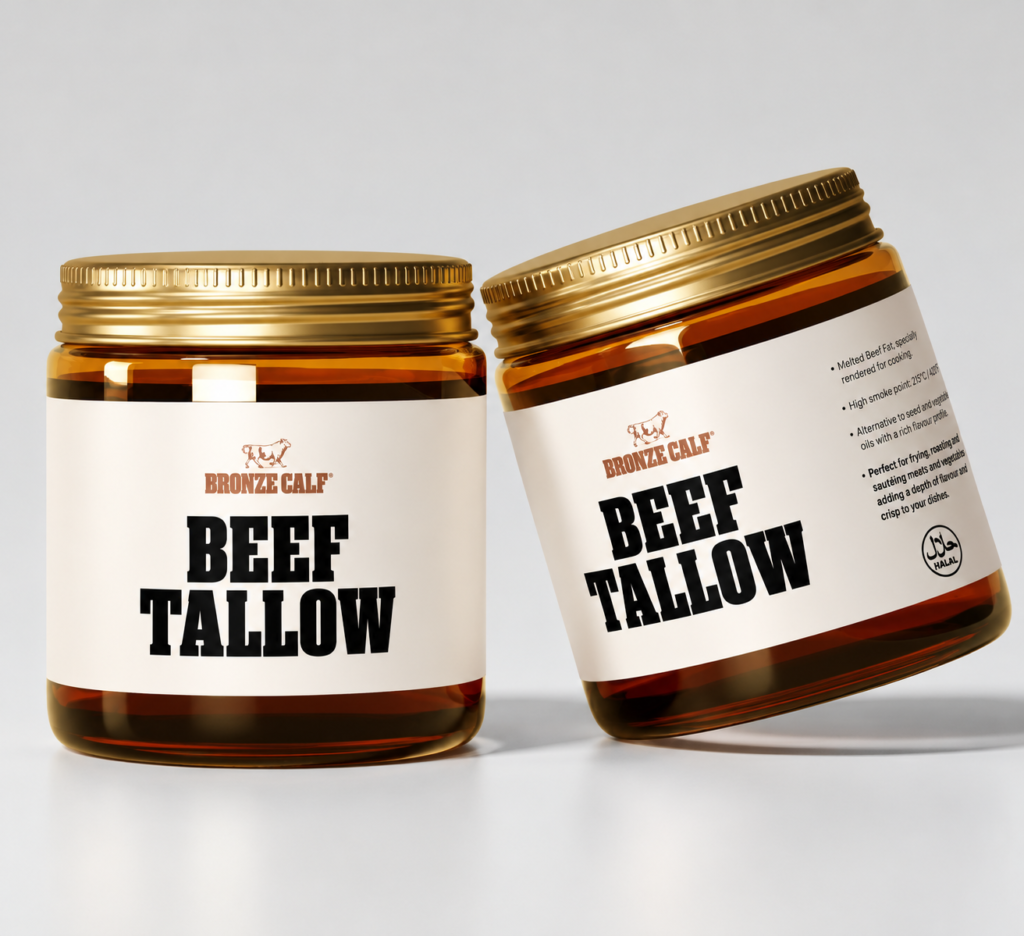
With so many cooking fats and oils available, you might be wondering how beef tallow compares to other fats you know – like vegetable oil, butter, lard, or coconut oil. In this comparative guide, we’ll pit beef tallow against some common alternatives and highlight the differences. By understanding these, you can make informed choices about when and why to use beef tallow in your kitchen.
Let’s start with a common point of confusion, especially in the UK: beef dripping. The terms “tallow” and “dripping” are often used interchangeably, and indeed, they’re extremely similar. Both refer to rendered beef fat. Historically, “dripping” specifically meant the fat that dripped from a roasting joint of meat, which was then collected and solidified. Tallow is a broader term that usually refers to fat rendered from suet (the raw beef fat) in a more controlled process. But in practice, beef dripping = beef tallow for most culinary purposes. If you see jars of beef dripping in a supermarket, that product is essentially pure beef tallow (sometimes with a slightly meatier flavor if not fully clarified). Both are solid at room temp, whitish, and used similarly for frying and roasting.
One minor difference: because dripping often comes from roasted meat, it may have browned meat juices in it (which can add flavor, but also moisture that could shorten shelf life). Commercial dripping usually is filtered though. Tallow (like Bronze Calf’s) is rendered in a way to remove any meat bits, yielding a clean, neutral fat. For cooking, you can treat dripping and tallow as the same – both fantastic for high-heat cooking and savory flavor. So yes, your grandma’s tin of dripping and your jar of tallow are kindred spirits!
Lard is the rendered fat from pigs, and it’s another traditional cooking fat much like tallow. Here’s how they compare:
Source & Flavor: Tallow comes from cows, lard comes from pigs. High-quality lard (especially leaf lard from around pig kidneys) has a mild, almost neutral flavor with a hint of porkiness. Beef tallow has a slightly stronger flavor – a beefy, savory note. When cooking, lard’s flavor is a bit more subtle, while tallow imparts more meaty depth. For example, in a pie crust, lard might be barely noticeable, whereas tallow might lend a hint of roast-beef aroma. This is why lard was prized for pastries (it doesn’t make your apple pie taste like bacon, for instance), and tallow was more for frying and robust dishes.
Texture: At room temperature, tallow is typically a firmer fat, and lard is softer (spreadable if at warm room temp). This is due to differences in fatty acid composition. Tallow has a higher melting point (around 45°C/113°F), whereas lard melts around 35-40°C (95-104°F). In practical use, this means tallow holds up better in high heat (it remains solid and stable in a hot kitchen), while lard being softer can integrate into doughs easily. But both can be scooped and measured similarly.
Smoke Point: Tallow’s smoke point (~400°F) is a bit higher than lard’s (which is around 370°F for refined lard). Both are good for frying, but tallow has the edge for super high-temp searing. Lard can start to smoke slightly sooner. Still, lard is far more heat-stable than most seed oils.
Health Profile: Nutritionally, both tallow and lard are high in calories and fats (obviously), but their fat composition differs. Lard contains a bit more monounsaturated fat (up to ~50%) and slightly less saturated fat than tallow. Interestingly, lard from pasture-raised pigs also contains some vitamin D (pigs synthesize vitamin D when exposed to sun). Beef tallow contains vitamins A, D, E, K as we noted, and a notable component – stearic acid – which some consider a relatively benign saturated fat. Neither contains trans fats unless artificially hydrogenated. When comparing “which is healthier,” it’s a nuanced call. Traditional cultures used both without issues, but modern dietary guidance would say both should be used in moderation. If someone avoids pork for dietary or religious reasons, beef tallow is the automatic winner as it’s acceptable (with halal/kosher sourcing) while lard is not.
Use Cases: Both tallow and lard are multi-purpose. Lard excels in baking (biscuits, pie crusts, tamales) and frying things like refried beans or tortillas (think of cuisines like Mexican which use lard traditionally). Tallow excels in frying (fries, deep-fried items) and cooking meats/vegetables where its flavor complements. In many recipes, you could swap one for the other and get a similar cooking performance. For example, you can fry chicken in lard or tallow and get a great result. It often comes down to flavor preference. Many people keep both on hand.
Bottom line: Lard and tallow are both superb, natural fats. Tallow is a great alternative to lard if you don’t consume pork, and it gives a beefy boost to dishes. If you’re making grandma’s pie crust, lard might be first choice for neutrality – but for roasting potatoes or searing steaks, tallow might win. At Bronze Calf, we obviously are team tallow 😉, but we respect lard as a fellow traditional fat. Both beat processed industrial shortenings by a mile.
This is a hot topic in health circles these days. Common vegetable oils include canola, soybean, sunflower, corn, etc. Let’s see how tallow stacks up:
Processing: Beef tallow is naturally rendered from animal fat with simple heat and filtering. Most vegetable oils are extracted from seeds using industrial processes (high heat, chemical solvents like hexane, bleaching, deodorizing). If you’re seeking natural, minimally-processed fat, tallow clearly has the advantage. Vegetable oils are among the most processed “foods” in our diet. Tallow is straightforward and what you see is what you get.
Fat Composition: Vegetable oils (except a few like coconut or palm) are mostly polyunsaturated fats. For example, corn oil and soybean oil are high in omega-6 polyunsaturates. These fats are liquid at room temp and are less stable – they can oxidize and go rancid more easily, especially when heated. Beef tallow is mostly saturated and monounsaturated fats, making it very stable under heat. This stability means tallow doesn’t break down into harmful compounds as quickly as polyunsaturated oils might at high temperatures. Some research even suggests that the oxidative byproducts from overheated vegetable oils could be more concerning for health than the saturated fat in stable fats like tallow or coconut oil.
Smoke Point and Cooking Performance: Tallow’s smoke point (~400°F) is comparable or higher than many refined vegetable oils. For example, refined canola oil has a smoke point about 400°F, sunflower around 440°F, but unrefined versions are lower. The big difference is what happens as they approach those temperatures. Polyunsaturated oils, even if their smoke point is high, can start forming polar compounds and oxidizing before visible smoke. Tallow, being saturated, stays intact longer. Practically, when you stir-fry or deep-fry, tallow will give you a great result and remain stable, whereas something like unrefined sunflower oil might burn or break down. If using a refined oil like peanut or vegetable oil, you might get similar frying performance, but you lack the flavor and you might be introducing more omega-6 fats into your diet than desired.
Flavor: Most vegetable oils are nearly flavorless (some might say they have a slight industrial or chemical taste when heated too much). Beef tallow has a meaty aroma and flavor that, in the right dishes, is a huge plus. Of course, if you need a neutral flavor (say, for a delicate dish or a light salad dressing), tallow wouldn’t be suitable. But for cooking hearty foods, tallow’s flavor is generally an enhancement. Think of it like cooking with broth or butter vs. water – tallow adds a base note of savoriness. There’s a reason fries in tallow became famous for their taste – the flavor is often described as richer than fries in plain oil.
Health Considerations: This is where debates rage. Traditional wisdom had it that vegetable oils were “heart-healthy” and animal fats were “bad.” However, modern discussions (and some emerging research) are questioning that narrative. Vegetable oils are high in omega-6 fatty acids, and excessive omega-6 intake is linked to inflammation and other issues when not balanced with omega-3s. Beef tallow contains some omega-6 but far less, and some omega-3 too, especially if grass-fed. Critics of seed oils argue that the high omega-6 content and the oxidation of these oils make them less healthy than we thought. On the flip side, saturated fat like tallow can raise LDL cholesterol in some people, which is a known risk factor for heart disease. The University Hospitals notes that tallow has vitamins and anti-inflammatory components, but also that its saturated fats can raise cholesterol. The American Heart Association still recommends limiting saturated fat for heart health. So where does that leave us? Many nutritionists now suggest using a variety of fats and avoiding overuse of any single highly refined oil. Olive oil (a mostly monounsaturated fat) is often recommended for everyday use, with saturated fats like tallow or butter used in moderation for high-heat or flavor purposes.
In simpler terms: If you’re frying once a week, using beef tallow is likely better than using an old batch of overheated soybean oil. If you’re drizzling oil on a salad, extra-virgin olive oil would be a healthier choice than melted tallow, due to olive oil’s well-proven benefits. It’s about using the right fat for the job. What’s clear is that tallow has none of the trans fats that partially hydrogenated vegetable shortenings had – that’s a plus. It also is free of additives. It’s calorically dense like any fat, so portion control matters. But we now know that naturally occurring saturated fats, in reasonable amounts, are likely fine for most people, especially when part of a diet that’s low in sugar and refined carbs.
Environmental Impact: Commercial vegetable oil production (soy, corn, palm) can be resource-intensive and involve deforestation (especially palm oil). Beef tallow, as a byproduct of the meat industry, utilizes existing resources. Of course, raising cattle has its environmental footprint too. However, if the cattle are already being raised for meat (which they are), using the fat is a more efficient use of the animal. In a sustainability sense, tallow is part of a circular approach – it’s recycling nutrients that already exist (mopac.com). Some small producers get tallow from local farms and thereby support local agriculture, whereas big vegetable oil might be a global commodity with a larger carbon footprint. It’s complex, but many sustainability advocates favor animal fats from ethical sources over industrial seed oils.
Summary: Beef tallow stands up strongly against vegetable oils for cooking needs: it’s more stable under heat, adds flavor, and is natural. However, it’s not as universal as a neutral vegetable oil for all purposes (like baking a light cake or making a vinaigrette – you wouldn’t use tallow there). Think of tallow as your go-to for frying, roasting, and robust sautéing, and you can still keep a bottle of olive or avocado oil for no-heat or low-heat uses (salads, gentle sauté). Many health-conscious cooks actually do exactly that – they avoid soybean/canola/corn oil and instead stock tallow, ghee, coconut oil for high heat, and olive or avocado oil for finishing and cold uses (uhhospitals.org).
Butter is another beloved cooking fat, as is its clarified form, ghee. How does tallow compare?
Composition: Butter is about 80-82% fat, with the rest being water and milk solids (proteins, lactose). Ghee is basically pure butterfat (clarified butter with the water and milk solids removed). So ghee is 100% fat like tallow, while butter has some water and can sputter when frying due to that moisture. Beef tallow, being pure fat, is more analogous to ghee.
Smoke Point: Butter has a low smoke point (~300°F) because the milk solids burn; ghee has a higher smoke point (~450°F) because those solids are gone. Beef tallow is around ~400°F. So for high heat, ghee and tallow are both excellent. Butter will burn quickly, so it’s not suitable for high-heat frying on its own (though you can mix butter and tallow to raise the smoke point while still getting butter flavor). Many chefs will sear in oil/tallow then finish with butter for flavor.
Flavor: Butter/ghee has a creamy, sweet flavor from milk components (and ghee often has a nutty, caramelized note from the browned milk solids that were in it). Beef tallow has a roasty, meaty flavor. They are quite different. If you want a dish to have buttery flavor (say, sautéed fish or baked goods), tallow can’t provide that. Conversely, if you want neutral or beefy flavor (fries, Yorkshire pudding), tallow might be better. Fun fact: Traditional English Yorkshire puddings and suet puddings were made with beef drippings/tallow – it gives them a distinctive savory taste.
Health: Butter contains a small amount of cholesterol and milk proteins, which some people avoid. Ghee and tallow are both free of lactose or casein (milk protein), so they’re both fine for dairy-sensitive individuals. Butter and ghee do have some vitamin A, D, E, K as well (grass-fed butter is notably high in vitamin K2). Tallow and ghee are nutritionally somewhat similar, though ghee has more short-chain fatty acids (like butyric acid) that are beneficial for gut health. Both butter/ghee and tallow have saturated fats; ghee has about 65% saturated fat, tallow around 50% saturated. Both have monounsaturated too (tallow ~40%, ghee ~30%). So health-wise, they’re in a similar category – traditional fats that can be healthy in moderation. Many keto folks use both ghee and tallow interchangeably.
Uses: Butter is king in baking for its flavor and moisture – tallow cannot replace butter in say, a pound cake or cookies in terms of taste. Ghee vs. tallow is a closer call: ghee is great for frying and Indian cooking, where its nutty flavor complements spices. Tallow shines in frying and searing meat, where its beefy note complements the dish. You wouldn’t spread tallow on your toast (unless you’re really hardcore carnivore diet!) whereas butter is delicious as a spread. But you might use tallow to baste a roasting meat, which you wouldn’t do with butter because it might burn.
In short, butter/ghee and tallow can coexist. Use butter for flavor and finishing, ghee for a high-heat dairy fat with butteriness, and tallow for a high-heat meat fat with savory depth. Some cooks will start a dish with tallow for the high heat capability, then finish with a bit of butter for flavor once the heat is lowered. That’s a great strategy to get the best of both worlds.
We’ll touch on this since coconut oil is another saturated fat often used by health-conscious cooks:
Source & Composition: Coconut oil is a plant-based fat, mostly saturated (like ~90% saturated!). It’s solid at room temp (melting point ~76°F) but melts in a warm kitchen. It has a distinct coconut aroma if using virgin coconut oil; refined coconut oil is more neutral. Beef tallow is about 50% saturated, 40% monounsat, 10% polyunsat. Coconut oil is mostly lauric acid (a medium chain fatty acid). Tallow has more long-chain fatty acids like stearic and oleic acid.
Smoke Point: Virgin coconut oil smokes around ~350°F (not very high). Refined coconut oil can go to ~400°F. Tallow around ~400°F as well. Both are fairly stable under heat due to saturation, but coconut oil’s lower smoke point (for virgin) limits it for high-heat searing. Tallow wins for deep frying or searing steak; coconut oil might burn and also impart a coconut taste.
Flavor: Obviously, coconut oil tastes like coconut (unless refined). That can be lovely in certain dishes (curries, baked goods, even some stir-fries) but odd in others (coconut-flavored French fries? No thanks). Beef tallow tastes like beef. So it depends on the recipe. You wouldn’t use coconut oil in a beef stew as a frying fat – the flavors would clash. Nor would you likely use tallow in a tropical curry that benefits from coconut flavor. So these two fats serve different flavor profiles.
Health: Coconut oil has been touted for health (MCTs, brain health, etc.) but also scrutinized for being so high in saturated fat. Tallow has somewhat less saturated fat and more variety. Coconut oil lacks vitamins that tallow has (no A, D, etc., since those are animal-derived). Both can be part of a low-carb or paleo diet. Coconut oil is obviously vegan, tallow is not. Some people who don’t eat animal products will prefer coconut oil as their “solid fat.” However, for someone open to animal fats, tallow might be considered more nutrient-dense due to vitamins. Both fats have anti-microbial properties (lauric acid in coconut oil can kill certain pathogens; tallow’s CLA and palmitoleic acid may have anti-microbial effects too). It’s a bit of a draw health-wise, each with pros and cons and lacking long-term conclusive studies. It might come down to personal tolerance and context (coconut oil in coffee vs. tallow in coffee – yes, some keto folks put tallow or butter in coffee for “bulletproof coffee”; coconut oil or MCT oil is more common, but tallow is used by some carnivore dieters).
Bottom line: Coconut oil and tallow can both be used for high-heat cooking, but they bring very different flavors. Coconut oil suits sweet and aromatic dishes; tallow suits savory and meaty dishes. Many kitchens have both – for example, you might pop popcorn in coconut oil for a hint of coconut flavor, but fry chicken in tallow for a hint of savory.
Choosing the right cooking fat really depends on what you’re cooking and your dietary needs. Here’s a quick guide:
For deep frying and ultra-crispy results: Beef tallow is a top choice (along with other animal fats like lard or duck fat). It will give you superior crunch and flavor for fries, fried chicken, etc., without breaking down easily(girlcarnivore.com). It outperforms most vegetable oils in this role, and you can reuse it.
For high-heat searing and roasting: Beef tallow or ghee are excellent. Tallow works especially well for roasting potatoes and veggies (adds meaty flavor), and searing meats (steak, chops) to get that steakhouse sear. Ghee works too if you want a buttery note. Avoid butter alone at high heat (it’ll burn).
For baking pastries: Lard or butter are usually first picks for their flavors. Beef tallow can be used in savory pastries or some bread, but it’s not common in sweet baking. If you’re experimenting or need a dairy-free option, you can try tallow in certain baked goods, but be prepared for a slight flavor difference.
For everyday cooking (moderate heat): It depends on flavor. Olive oil is great for Mediterranean dishes or when you want a lighter taste and proven heart benefits. Tallow can be your go-to for everyday frying of eggs, sautéing onions, browning ground meat, etc., especially on a low-carb or paleo diet where animal fats are welcome. Many people simply prefer the taste of foods cooked in tallow – e.g., scrambled eggs in a bit of tallow are delicious and satisfying, with no need for butter.
For diet-specific needs: If you’re keto or carnivore, you might use beef tallow almost exclusively for cooking, since it adds fat without any carbs and aligns with animal-based eating. If you’re vegan, obviously tallow is out and you’d use coconut oil or vegetable oils. For Whole30 or paleo, tallow is approved and a great option to avoid processed oils. If you have to limit saturated fat strictly for medical reasons, you might lean more on oils like olive/avocado and use tallow sparingly as a “sometimes treat” for that Sunday roast.
A quick note on Halal/Kosher: As mentioned earlier, beef tallow (when sourced from appropriately slaughtered cattle) is permissible, whereas lard is not. So in recipes calling for lard (like certain traditional pastries or refried beans), you can use tallow to make it Halal-friendly. It’s a swap that retains much of the authenticity without using pork.
Ultimately, each fat has its place in a well-rounded kitchen. Beef tallow is unique for its combination of high heat performance, flavor enhancement, and historical pedigree. It’s not about tallow replacing every other fat, but rather adding to your culinary toolkit. By having tallow on hand, you have the option to cook things in the old-fashioned, time-tested way – and often, that yields the tastiest results.
If you’re new to beef tallow, try using it in place of your usual cooking oil for a week and see how you like it. You might discover that vegetables get eaten faster, meats brown better, and your kitchen smells wonderfully like a hearty bistro. And remember, quality matters: a clean, grass-fed beef tallow (like Bronze Calf’s Pure Beef Tallow) will have a fresh, pleasant smell and flavor, without any off-notes, making all the difference in these comparisons. Happy cooking, and enjoy the best of all fats in their rightful uses!